
Wiki Cluster
How to Play Parkour Champions (Roblox)
A practical beginner guide for Parkour Champions [BETA] by Studio 8K. Learn the game’s core loop, what to focus on early, and how to improve faster without wasting Coins or Spins.
Quick Links
Parkour Champions Key Art
Important: Avoid Game Name Confusion
This guide targets the Roblox experience “Parkour Champions [BETA]” by Studio 8K. Roblox has multiple parkour games with similar names, and they do not share the same systems or codes.
If something in your UI doesn’t match, first confirm you’re in the correct experience and not a different Roblox parkour title.
What Parkour Champions Is (In One Clear Sentence)
Parkour Champions is an anime-inspired parkour and racing experience on Roblox where the fastest players aren’t just “good at jumping”—they’re the players who can keep momentum by chaining movement actions and using Champion/Style abilities in the right order.
Most guides describe the setting as an open city-style map where you move between tasks, races, and progression checkpoints. The tone is high-energy and competitive, but it also rewards personal expression: the best runs look like a smooth movement “flow,” not random spam.
The most helpful mindset is: you are learning a movement language. Your goal is to create a repeatable chain (jump, vault, wall run, swing, slide, dive, and your Style abilities) that keeps your speed consistent while you choose efficient routes.
The Core Loop (The Only Loop That Matters Early)
If you feel lost, return to this loop. It’s the structure behind almost every Parkour Champions guide and the foundation for this wiki cluster.
1) You play races, story/act content, and tasks to earn resources. 2) You use Coins and Spins to unlock and improve your options. 3) You test combinations of Champions and Styles to find a movement kit that fits your hands. 4) You repeat, but now you clear content faster and with fewer mistakes.
When you see terms like Champions, Styles, Spins, and Coins, they all exist to support that loop. Your goal is not to “collect everything,” but to reach a consistent kit that helps you learn movement and finish runs smoothly.
Your First 30 Minutes (A Simple, Low-Stress Plan)
Minute 0–5: set up your controls and camera. Parkour games punish awkward inputs. Before you even chase speed, make sure you can reliably jump, slide, and wall run without fighting the camera. If you’re on PC, it helps to practice a short loop: run forward, jump, slide on landing, then jump again. Repeat until your hands stop hesitating.
Minute 5–15: practice movement chaining in a safe area. The goal is not a perfect route—it is a clean rhythm. Every time you lose speed, ask why: did you land at a bad angle, overuse slide, mistime a jump, or collide with geometry? The fastest improvement comes from identifying one repeating mistake and fixing it.
Minute 15–25: do a few tasks/races with a single objective: finish cleanly. If you crash, don’t reset instantly—try to recover and complete the run. Recovery skills are what convert a “good movement player” into a “consistent racer.”
Minute 25–30: decide a resource rule. Choose how you will spend Coins and Spins. Early players often waste resources chasing novelty instead of consistency. A good early rule is to prioritize anything that makes movement feel more controllable and repeatable for you, not just whatever looks flashy.
Beginner Priorities (Do These Before Meta Chasing)
- ✓Prioritize movement consistency: clean landings and repeatable chains matter more than rare picks early.
- ✓Use codes early when available: many guides recommend redeeming codes first so you can unlock options and remove early bottlenecks.
- ✓Treat routes as a skill: the “best” route is the one you can repeat under pressure without crashing.
- ✓Avoid mixing information from other Roblox parkour games: they can have different keybinds, different currencies, and different code systems.
What “Getting Faster” Really Means (Momentum, Not Just Speed)
Parkour Champions is often described as a momentum game. That means your speed comes from keeping a chain alive. If you stop, collide, or take a jump that forces a hard turn, you don’t just lose one second—you break the rhythm and end up losing multiple seconds.
A clean run usually has three repeating phases: acceleration, control, and transition. Acceleration is where you build speed (usually along a straighter line). Control is where you maintain speed while navigating obstacles. Transition is where you change direction or elevation without killing momentum.
If you want a single improvement rule: reduce “panic inputs.” Panicking creates extra jumps, wrong-angle slides, and late wall runs. Instead, slow your inputs down and aim for fewer, better actions.
Routes and Shortcuts (How to Practice Without Guessing)
Guides often mention hidden shortcuts and higher-risk, higher-reward paths. You don’t need to find every shortcut immediately. What you need is a method to test them.
Use a three-run test. Run A is the safe route you can complete 9/10 times. Run B is the new shortcut attempt. Run C is a repeat of the shortcut. If you can’t complete Run C cleanly, the shortcut is not ready for real races yet.
Also be honest about your current skill. A shortcut that saves one second in theory can lose five seconds if it causes a crash. For most beginners, the “best shortcut” is actually a clean transition that avoids a wall collision.
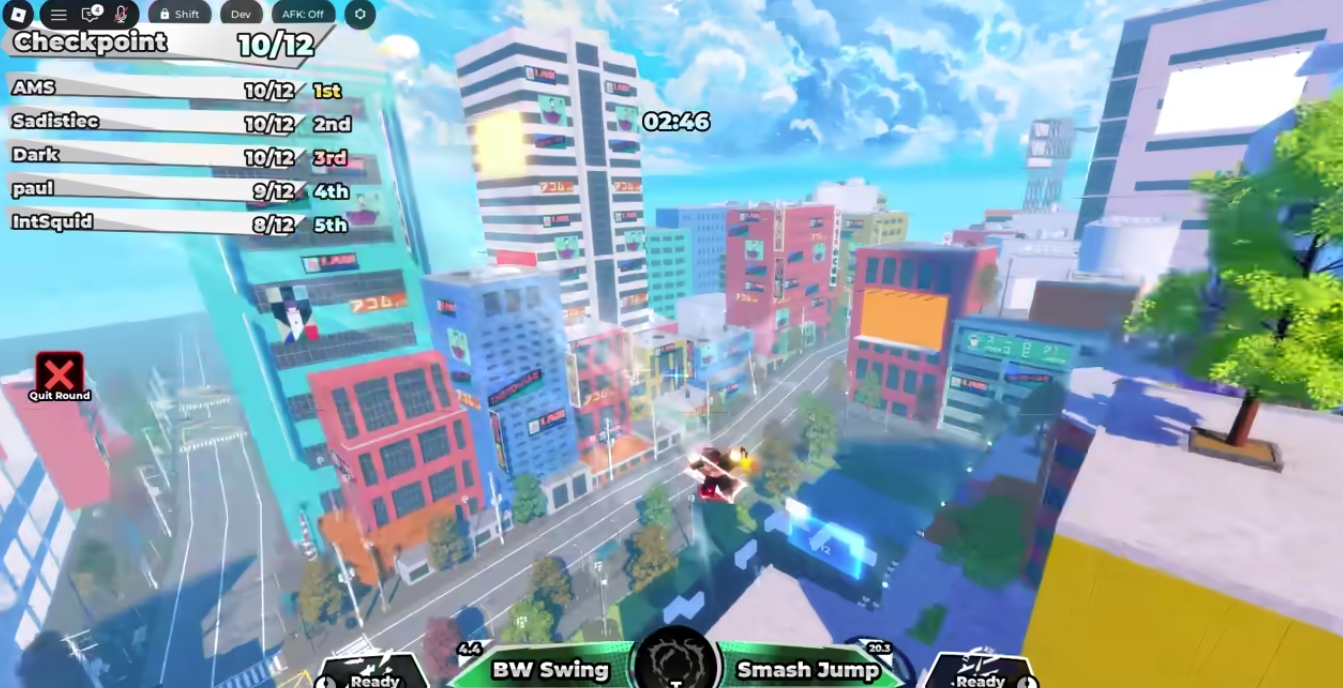
Race View (Checkpoints and City Routes)
Progression Without Regret (Coins and Spins as a Budget)
Most descriptions of the game’s progression emphasize Coins and Spins as your unlock path. Think of those resources as a budget for learning: each spend should either make your movement more controllable or help you test a meaningful new option.
If you are unsure what to buy or roll, stop and read the systems page first. Understanding the terms (Champions, Styles, Spins, and super variants) reduces wasted spending because you know what each roll is actually doing.
A healthy beginner strategy is to split spending into two buckets: a “core kit” bucket and an “experiment” bucket. Your core kit bucket exists to make you consistent. Your experiment bucket exists to keep learning and prevent boredom. The biggest mistake is spending 100% of your budget on experiments.