
Wiki Cluster
Ores Traits & Tier List (Practical)
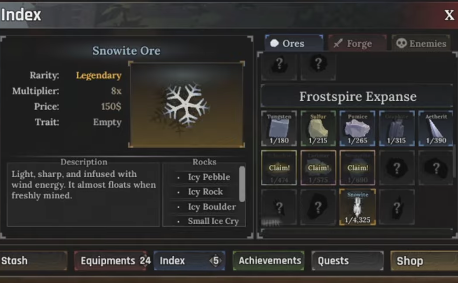
Not every rare ore is worth forging. This page explains a simple, useful tier logic, then positions Snowite (weapon-only slow) versus Frostspire alternatives.
Quick Links
Snowite (The Control Benchmark)
A Tier List That Actually Helps (3 Questions)
Instead of arguing about one “best ore”, rank ores by the job you need them to do. For most players, these three questions decide value:
1) Is the effect reliable (or does it require repeated hits / RNG procs)? 2) Does it work on the slot you care about (weapon-only vs armor)? 3) Does it change fights in a way you feel (control, survivability, burst, farming speed)?
If you can answer those three questions, you can build your own “tier list” that matches your playstyle. That’s more useful than copying a one-size-fits-all ranking that assumes everyone fights the same enemies with the same weapons.
This page uses Snowite as a reference point because it represents a common kind of value: a combat trait that improves your ability to control fights. When players call an ore “S tier”, they usually mean it changes fights, not just economy.
Four Tiers That Map to Real Decisions
S (Build-Defining): traits that change fight outcomes consistently or enable a specific strategy. These are ores you plan around rather than “throw in”.
A (Strong Upgrades): traits that are clearly beneficial but don’t require you to change your entire playstyle. They are great for general progression and safe forging decisions.
B (Situational): powerful only in certain matchups, weapon types, or routes. They can be amazing if you know why you want them, but average if you copy them blindly.
C (Economy / Fillers): ores you keep for sell value, for visual looks, or to fill recipes when you lack better materials. They can still be useful, but not primarily for combat power.
Slot Matters: Weapon Traits vs Armor Value
A big mistake in tier discussions is ignoring the gear slot. A trait can be incredible on a weapon but meaningless on armor, and vice versa. Snowite is commonly described as weapon-only for its slow proc—so it belongs in “weapon trait tiers” more than “overall ore tiers”.
When you read any ore trait list, always ask: does it trigger on hit, on being hit, on movement, on time, or passively? Triggers tell you which slot it belongs in and which play patterns will actually activate it.
Once you separate weapon tiers from armor tiers, most confusion disappears. You stop asking “Is this ore good?” and start asking “Is this ore good for the weapon plan I’m committing to?”
Frostspire Trait Snapshot (Conceptual)
| Ore | Trait Style | Best For | Notes |
|---|---|---|---|
| Snowite | Soft control (slow) | Chasing, PvP tempo, pressure builds | Often listed as weapon-only with an on-hit slow proc. |
| Iceite | Hard control (freeze-style) | Lockdowns, stopping escapes, setup plays | Commonly described as a freeze effect; details vary by source/update. |
Snowite Tier Guidance (Why It Ranks Well)
- ✓Control is universally useful: it helps both offense (sticking) and defense (creating spacing).
- ✓Weapon-only traits are fine when you commit to a “main weapon” plan; they’re weaker if you want broad gear flexibility.
- ✓A proc-based slow shines in longer fights where you land multiple hits (more chances to trigger).
- ✓It helps both PvE and PvP: even in PvE, reducing enemy tempo can lower incoming damage and make routes safer.
- ✓It is “feelable”: even small movement/attack slow changes are noticeable, which makes it easier to evaluate in-game.
How to Rank Any Ore (A Repeatable Method)
Step 1: write the trigger. Example: “on hit”, “on being hit”, “passive”. If it’s on-hit, it wants a weapon plan that hits often; if it’s on-being-hit, it wants an armor plan that expects to tank.
Step 2: write the fight impact in one sentence. Example: “creates a chase window”, “reduces incoming DPS”, “enables burst setup”. If you can’t describe the impact, you can’t rank the ore yet.
Step 3: measure reliability. Proc-based effects are not bad, but they must be judged by how often you realistically trigger them in your normal fights.
Step 4: assign a tier within a category (weapon or armor) and stop trying to force a single global ranking. This prevents the common mistake of overvaluing weapon-only traits for players who rarely fight.
Cross-Link: Tier List → Calculator
Once you know what effect you want, the next question is “how do I mix ores to get it consistently?”. Use the calculator page to test combinations before you spend rare materials.